
 Back to Travel Notebook
 Verdant Retreats Where Horticulture Meets Hospitality
In some of the most memorable hotels we have visited, the garden is so much more than mere backdrop. It is the first welcome, the source of dinner or the taste of your cocktail, a place of intoxicating scents, and a shady escape. And, more often than not, it’s a story.
This Travel Notebook is an invitation over the garden wall, into places where horticulture and hospitality are beautifully entwined. From the historic food gardens of Babylonstoren in South Africa’s Franschhoek Valley to the apple-lined walls of The Newt in Somerset, from William Robinson’s romantic wildness at Gravetye Manor to the fynbos-rich wilderness of Bushmans Kloof, each property’s story is rooted in the land and the seasons.
Come along and meet the master gardeners who lovingly tend these colorful plots, where herbs are gathered for tea, flowers are pressed in workshops, peaches are warmed in the glasshouse sun, and icy rooibos tea is served by the pool. And whether you’ve been once or many times, we promise each visit to these garden retreats to be different, changing with the weather, the soil, and the gardener’s hand.
Babylonstoren, Franschhoek Wine Valley, South Africa – A Living Garden of Wonder
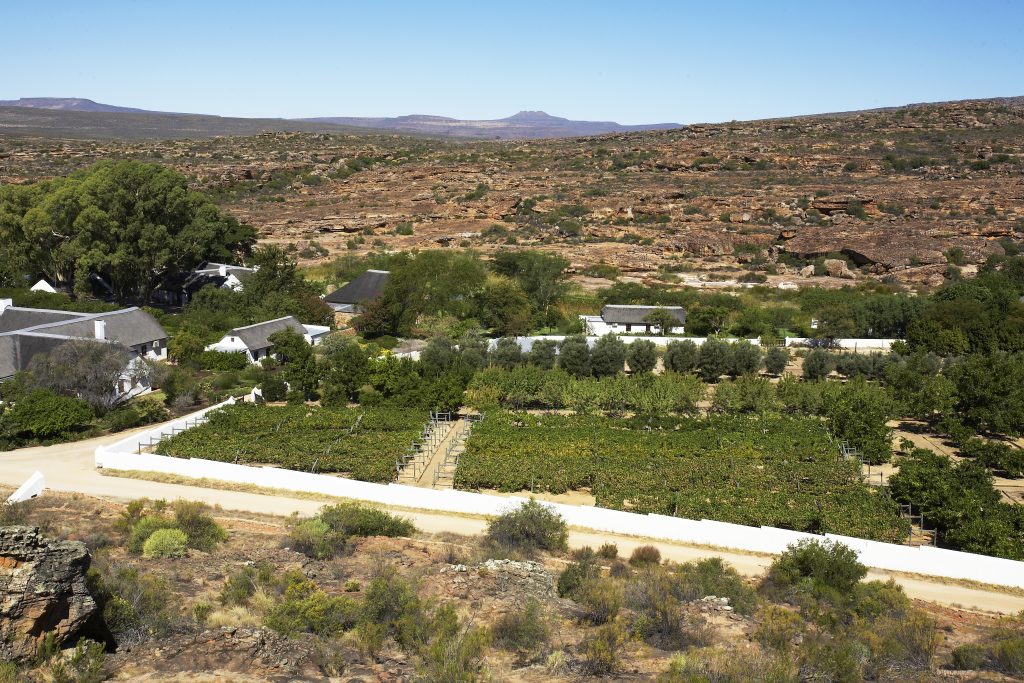
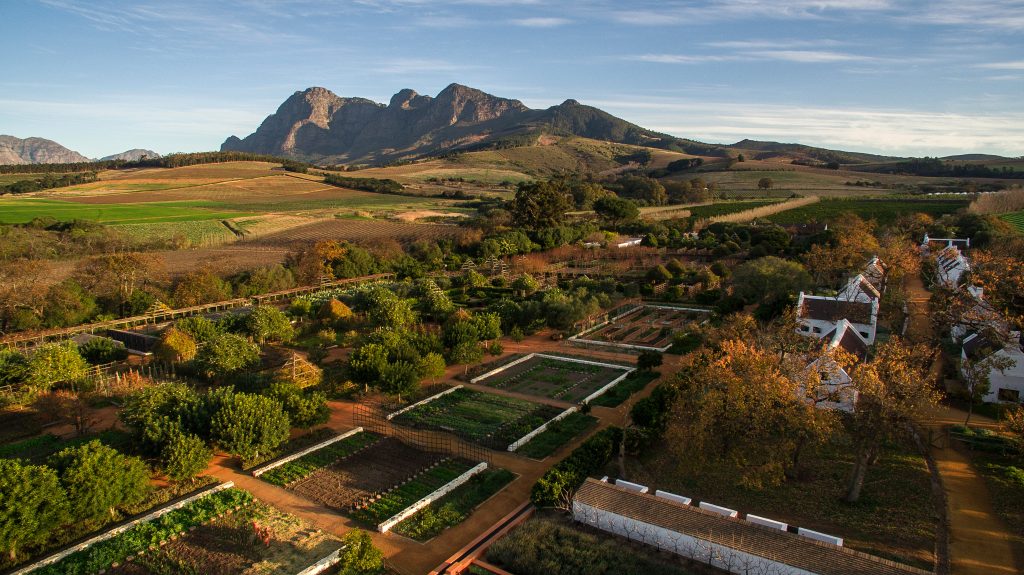 Cradled by mountains and bursting with life, Babylonstoren from above looks less like a farm
and more like a living tapestry of horticultural art.
Since the foundation of Babylonstoren in 1692, each new decade has left its own impression. When the current owners moved to the farm in 2007, they quickly grasped the historical value of what remained. At the same time, they set out to establish something for the future.
At the heart of the farm, a food garden of beauty and diversity was created — inspired by the historic Company’s Garden in Cape Town. This garden offers not only a sense of old-world romanticism, but also serves as the living stem onto which new dreams continue to be grafted.
Before long, the farm expanded organically: a hotel, restaurants, a kitchen garden, a healing garden, and a spice garden emerged. Collections of cycads, clivias, climbing roses, and succulents arrived, alongside a remarkable variety of plant species. The surrounding farmland became a hive of activity — orchards and vineyards preserved, while new crops such as olives, almonds, dragon fruit, prickly pears, rice, and honeybush tea were introduced. On the slopes of the Simonsberg foothills, indigenous fynbos enrich the landscape.
Everything at Babylonstoren is farmed as close to nature as possible. With growing creativity came a deeper investment in science, and today some of South Africa’s finest botanists work alongside gardeners, students and visitors who come to learn, observe and lend a hand.
The Signature Scent and Sight
If a guest stands in the garden in the evening, the day begins to soften into something almost tangible. The scent is layered — citrus leaves warmed by the sun, the herbal sharpness of thyme and rosemary underfoot, and the faint sweetness of ripening fruit drifting in from the orchards. Depending on the season, there may be the green freshness of summer growth or the richer, earthier notes of autumn’s slow decay.
The light settles into a deep, honeyed gold. It catches on the leaves, illuminating their veins before slipping into shadow. Rows of fruit trees glow softly, while climbing roses hold the last warmth of the day. Beyond the garden walls, the mountains absorb the fading light, anchoring the scene in stillness.
The Protagonist: The Gardener
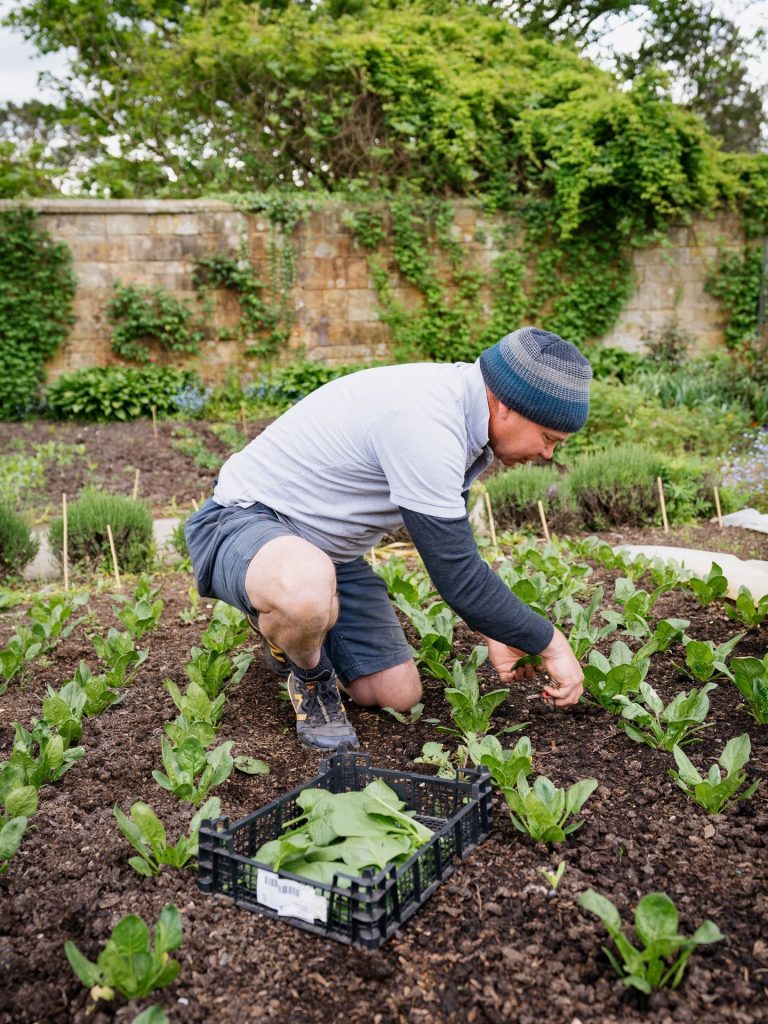
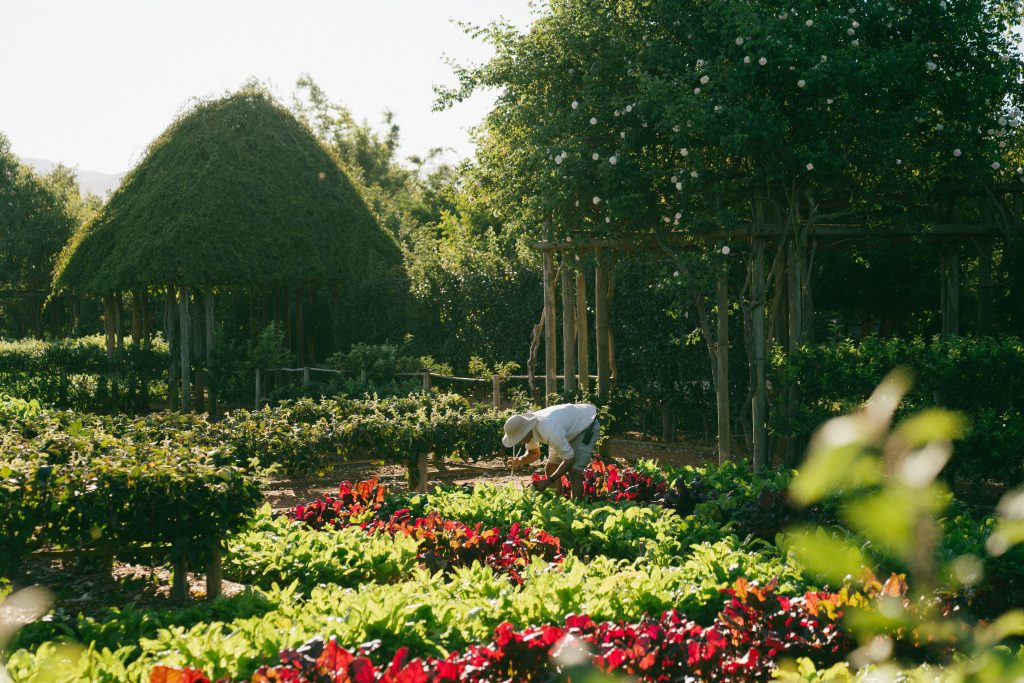 There is nothing quite like the satisfaction of harvesting crisp, seasonal produce.
At Babylonstoren, the boundary between a spectacular public garden and a
working, productive farm completely dissolves.
The garden at Babylonstoren is shaped by a dedicated team rather than a single hand — a collective of gardeners and botanists whose work begins long before guests arrive in the pathways. Many have spent years on the farm, developing an intimate understanding of its rhythms. Others arrive as students, drawn by the opportunity to learn in a place where horticulture is both practical and considered.
Ask about a favorite plant, and the answer often reveals something personal: a clivia admired for its resilience, a heritage fruit tree that has stood through decades of change, or a medicinal herb whose quiet purpose lies in the healing garden. What connects them all is a shared respect for the slow, attentive work that keeps the garden alive.
The Garden-to-Guest Connection
At Babylonstoren, the garden does not simply surround the guest — it hosts them. Produce harvested in the morning appears on the table the same day. Citrus finds its way into evening drinks, herbs into teas, and vegetables into seasonal dishes that reflect the garden’s current abundance. The connection is immediate and tangible.
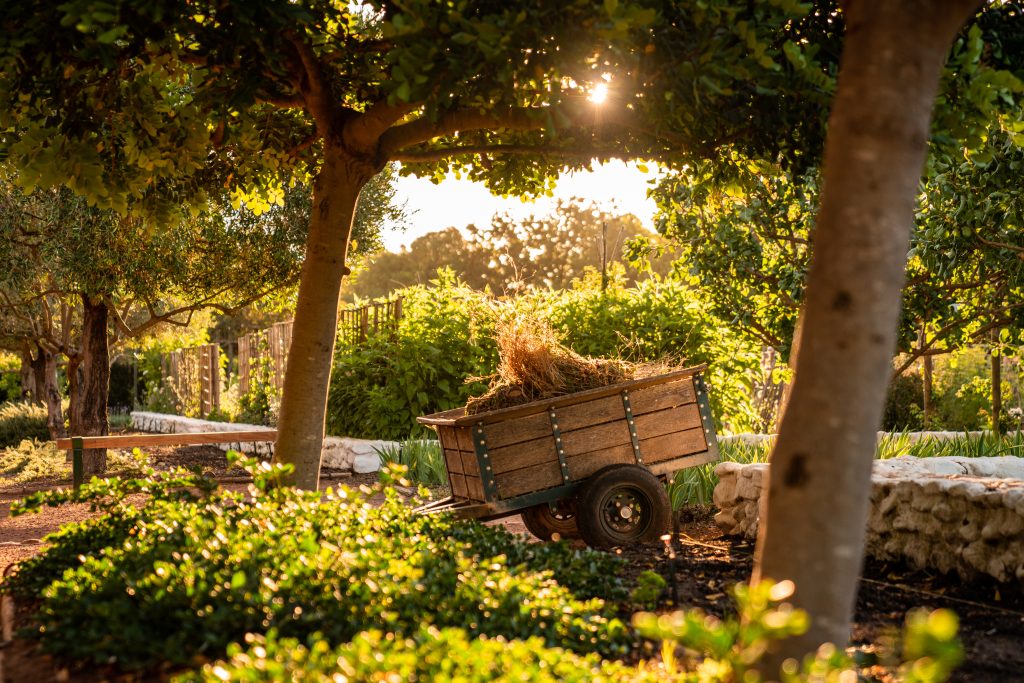 A beautiful reminder to slow down and appreciate the interplay of light and shadow.
The way the sun filters through the trees here transforms a simple
gardening scene into a living painting.
Guests are free to wander, to pause, to sit where they feel drawn. There are hidden corners and quiet benches where moments unfold naturally — a conversation, or simply a sense of stillness. Even the wider farm participates: bees in the apiary, fish in the dams, and donkeys quietly observing the passing day.
The Horticultural Hero
Among the garden’s many collections, the indigenous cycads stand as silent witnesses to time. Often referred to as “living fossils,” cycads date back millions of years, long before flowering plants existed. Their presence anchors the garden in deep history.
A lesser-known detail is their reliance on highly specialized insect pollinators, often specific beetle species. This intricate relationship is carefully maintained within the garden, highlighting the delicate balance that sustains even the most ancient forms of life.
The Insider Secret
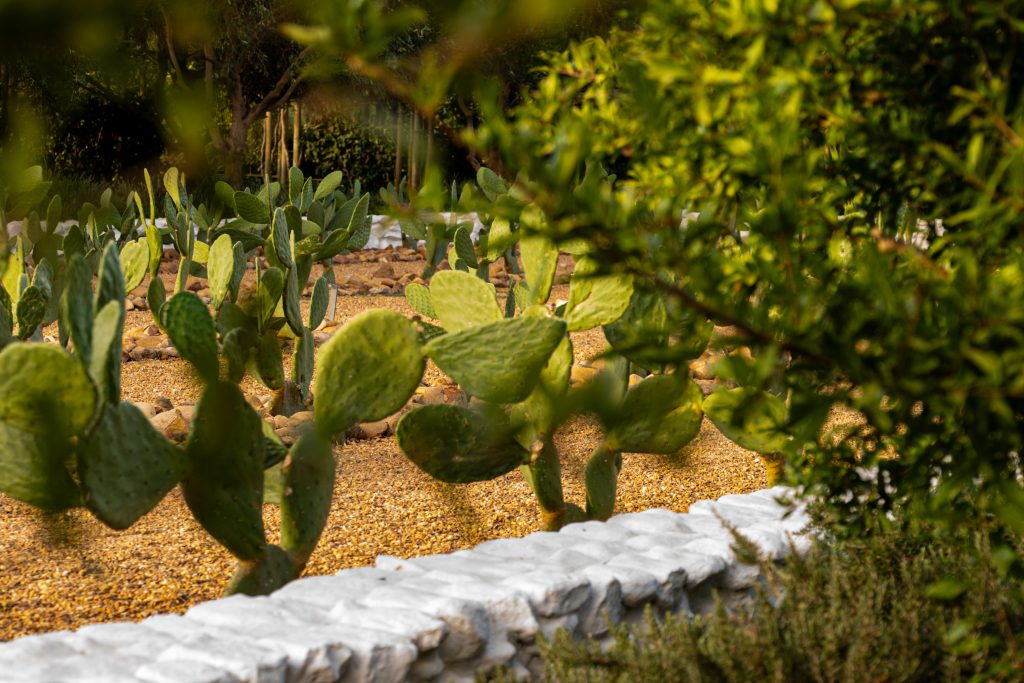 Tucked away within the lush, soft greenery of the estate lies the striking prickly pear maze. Peeking
through the foliage reveals a beautiful exercise in texture—where the bold, architectural shapes of
the cacti stand in sharp, magnificent contrast to Babylonstoren’s signature whitewashed stone walls.
Guests might ask one of the gardeners to point them to a hidden spot, places where the garden feels quietly discovered. Here, they may find themselves on a bench in the Healing Garden, where medicinal plants grow quietly; along the clivia stream, where thousands of clivias flower in September and October beneath indigenous wild olives and old oak trees; or in the Succulent House, home to a remarkable collection of indigenous species.
The Seasonal Pulse
 A Living Blueprint: Looking straight down at Babylonstoren reveals the absolute genius of its
formal layout. This bird’s-eye perspective transforms the massive 15-block garden
into a living tapestry, demonstrating how strict geometric precision can
elegantly house an incredibly diverse, working ecosystem.
The garden moves in a constant cycle, reflecting nature’s rhythm. Spring brings a surge of growth — blossoms, new shoots, and the anticipation of fruit. Summer follows with abundance, as orchards and vegetable beds reach their peak. Autumn deepens the garden’s character, with richer colors and scents, while winter reveals its underlying structure and allows the soil to rest.
There is this beautiful saying that a garden is like someone you love — there is something beautiful about them in every season. It also depends on what you would like to see when you visit: at Babylonstoren, it is blossoms in August, clivias in September, blooming rose towers in November, or berries, plums and lotus flowers in December.
Today, Babylonstoren welcomes guests from around the world, alongside locals seeking a moment of escape. Here, one can wander freely, enjoy a seasonal meal, or simply sit and observe as nature continues its quiet work.
No matter how time is spent on the farm, the cycles of nature remain constant and generous. Guests leave with a renewed awareness of life’s delicacy and a sense that something essential has been restored.
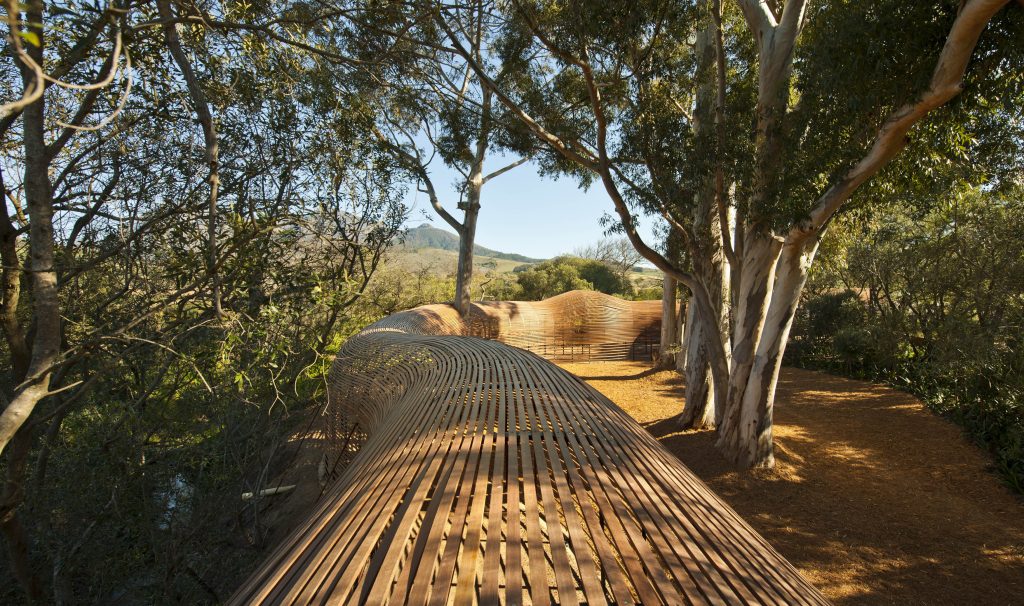 Design Mimicking Nature: Named for the distinctive African snake, Babylonstoren’s iconic Puff
Adder walkway meanders effortlessly through a grove of mature wild olives and towering bluegum
trees. This slatted timber structure is a masterclass in architectural shading, creating a constantly
shifting play of light and shadow that protects the delicate understory plants below.
At Babylonstoren, you come to understand that we need wonder as much as we need the air we breathe.
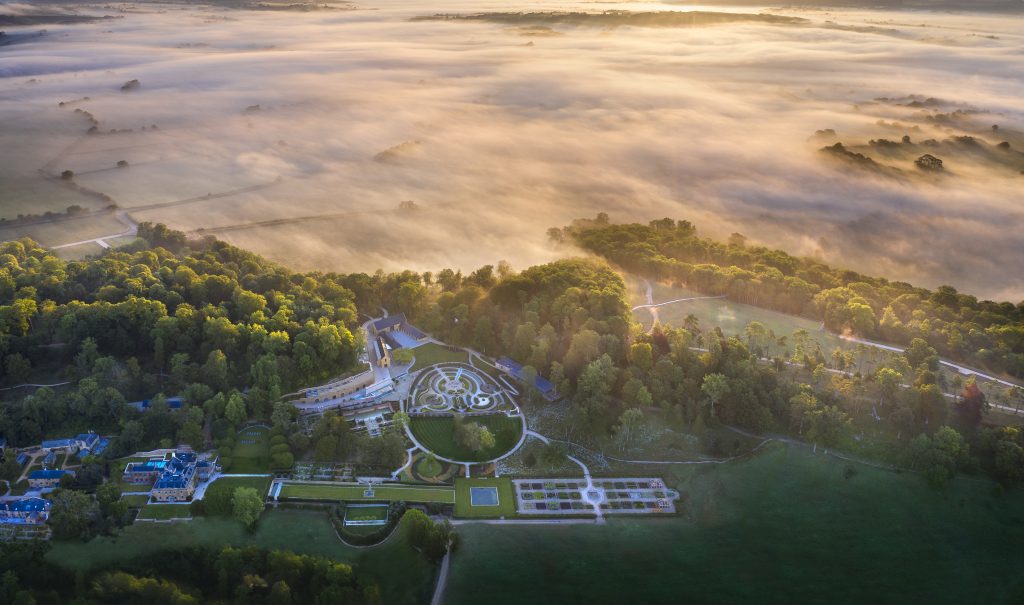 A spectacular sunrise over The Newt in Somerset (Babylonstoren’s UK sister estate). This stunning
aerial shot captures the rolling morning mist lifting to reveal the immaculate formal gardens,
productive orchards, and ancient woodlands. It feels less like a modern estate
and more like a scene from a classic English storybook.
At six in the evening, a stillness settles across the estate. If a guest is standing at the edge of the Colour Garden, just beyond the Hadspen Bar, they can breathe in the unmistakable Somerset scent — green, fresh, and vibrant. The light plays its part, too: as the evening light begins to dim, the white flowers glow. Listen closely, and you’ll hear a symphony of 66 bird songs.
Behind the beauty of the gardens at The Newt in Somerset is Head Gardener Harry Baldwin, who has worked at the estate for nearly two years. When asked his favorite plant on the estate, he won’t point towards a showpiece, but instead outward — beyond the formal gardens, into the quiet margins of the estate’s woodlands. There stands the ancient Fagus sylvatica, a beech tree that has been part of the Somerset landscape for centuries, a reminder that Hadspen’s horticultural history spans well before The Newt. In spring, bluebells surround the tree, carpeting the ground with color before the tree’s vibrant green leaves unfold for the season. Later, the leaves deepen into a tawny, burnished hue, lasting well into the colder months.
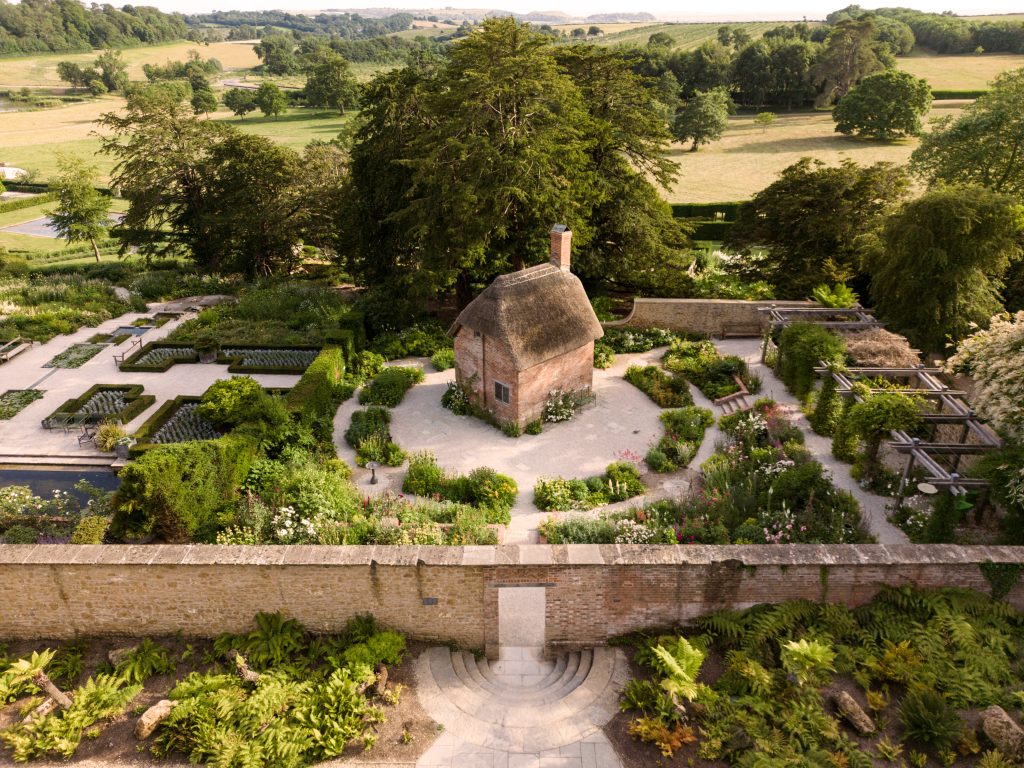 A Fairytale Corner of Somerset: Tucked away behind historic stone walls, this enchanting thatched
cottage serves as the focal point for a breathtakingly romantic pocket garden. With its concentric
pathways spilling over with lush summer perennials and a grand timber pergola,
it feels like stepping directly into a classic English storybook.
What makes the gardens remarkable is not just what grows here, but how it is shared with The Newt’s guests. As Harry points out, there are deliberately no barriers. Guests are invited to step in, to touch, to taste. In the Parabola, guests can taste 330 varieties of dessert apples — many of which are rare and heritage — that line the stone walls. Beyond the Parabola, flowers are gathered for pressing workshops; herbs are taken from the medieval garden for spa treatments; and garnishes are picked from the greenhouse for the Hadspen Bar.
A recent project for Harry has been bringing a new plant palette to The Newt with the expansion of its rose collection. His favorite variety: the elderberry rose. Its foliage is deep purple, contrasted with its penny-sized white flowers.
At The Newt, plants are not rare for the sake of rarity or arranged for spectacle alone. Instead, they are chosen — carefully and consciously — to invite curiosity and shape each and every guest’s experience.
Gravetye Manor, Sussex, United Kingdom – Where Horticulture Meets Hospitality
 Dine with a view: Experience the most stunning, ever-changing landscape view from
Gravetye Manor’s glass-enclosed Michelin-starred restaurant.
The gardens at Gravetye Manor are not simply ornamental grounds surrounding a hotel; they are among the most historically significant and influential gardens in England. Created by the pioneering Irish gardener and writer William Robinson in the late 19th century, Gravetye became the living embodiment of his revolutionary philosophy: that gardens should work in harmony with nature rather than attempt to control it.
At a time when formal Victorian bedding schemes dominated Britain, Robinson challenged convention entirely. Through influential books such as The Wild Garden and The English Flower Garden, he championed naturalistic planting, seasonality, and the idea that gardens should feel abundant, romantic, and alive. When he purchased Gravetye Manor in 1884, he transformed the estate into a working experiment of these ideas, blending productive gardens, wildflower meadows, woodland planting, orchards, and herbaceous borders into the surrounding Sussex landscape.
Today, Head Gardener Tom Coward continues that philosophy with immense care and sensitivity. Widely respected within the horticultural world, Tom has become known for preserving the spirit of Gravetye while allowing the gardens to evolve naturally with the seasons. Before arriving at Gravetye, Tom trained and worked at some of the country’s most respected gardens, building a reputation for his deep horticultural knowledge and thoughtful, naturalistic approach to planting. Since 2010, he has overseen the restoration and evolution of the Gravetye gardens, carefully reviving many of Robinson’s original ideas while allowing the estate to continue evolving naturally with the seasons.
Tom often says it is impossible to choose a single favorite plant at Gravetye, where every season brings something entirely different to admire. However, he does have a particular interest in snowdrops and the many different varieties of Galanthus. Their delicate white flowers emerging through cold ground in the depths of winter mark the very first signs of the garden awakening again. For Tom, they perfectly capture the subtle beauty and quiet seasonality that define the estate, with each variety possessing its own slight differences in form, markings, flowering time, and character.
The gardens unfold in layers throughout the year. In early spring, the bubble gum pink Magnolia campbellii bursts into life alongside the daffodils, followed hotly by riots of tulips and azaleas. One of the most spectacular moments of late spring comes when the white wisteria Shiro Noda flowers across the pergola. Its long, cascading racemes create a tunnel of scented white blooms. Walking beneath it has become one of the defining experiences of the garden and a particular seasonal highlight for guests and gardeners alike.
Beyond the formal gardens lie the species-rich wildflower meadows, one of the estate’s most important and quietly beautiful features. Wildflower meadows are now considered one of Britain’s most endangered habitats, yet at Gravetye they continue to thrive. In early summer, the meadows shimmer with oxeye daisies, buttercups, knapweed, orchids, and native grasses, alive with pollinators. They are not only ecologically important but central to Robinson’s original belief that cultivated gardens should feel intrinsically linked to the surrounding countryside.
The jewel in the crown of the garden is, without doubt, our elliptically shaped walled kitchen garden. Everything harvested here finds its way into the restaurant, often within hours. The connection between garden and table is immediate and instinctive, chefs working closely with the gardeners each day to shape menus around what is at its peak.
This relationship between landscape and cuisine is perhaps best experienced in Gravetye’s Michelin-starred dining room. With its glass-fronted views overlooking the gardens, guests have front-row seats to the changing beauty of the estate throughout the seasons while enjoying dishes made with ingredients harvested from the very gardens surrounding them. Whether it is spring asparagus, summer tomatoes, orchard apples, or delicate edible flowers picked that morning, the experience creates a rare sense of immediacy between what is growing outside and what arrives on the plate.
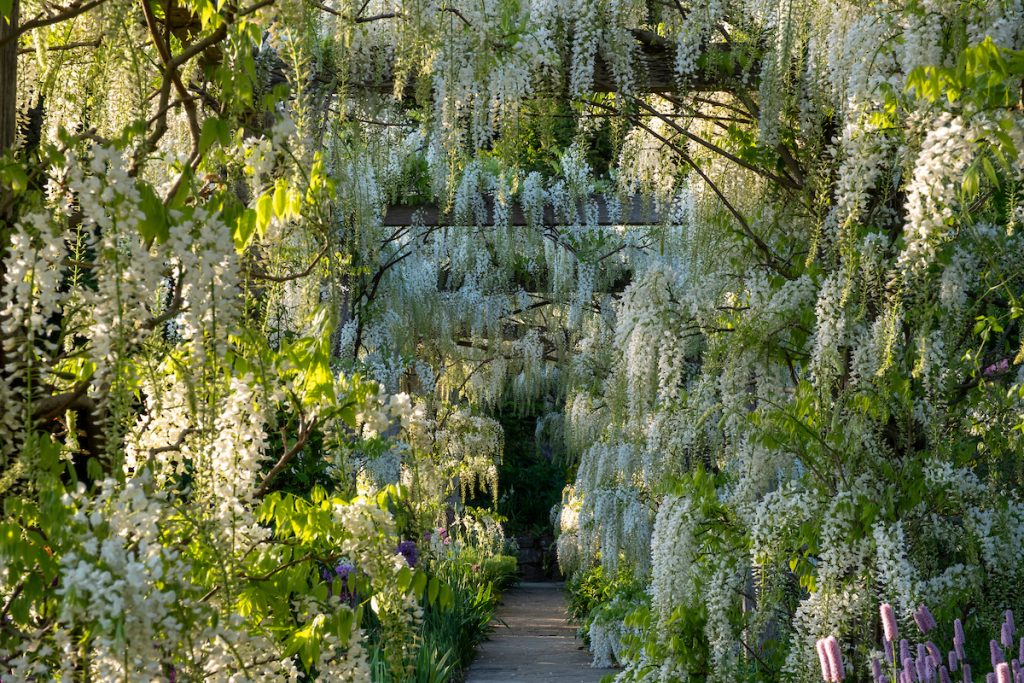 A spectacular view down one of Gravetye’s most enchanting pathways. The dripping white blooms
create a sense of romantic abundance, demonstrating how hard landscaping elements like pergolas
are at their absolute best when completely enveloped by nature.
One particularly special corner of the productive garden is the Peach House, originally built during William Robinson’s time at Gravetye and carefully restored by the estate in 2012. Stepping inside feels like entering another world, warm, fragrant, and filled with sunlight filtering through the glass onto carefully trained peach trees. One of the great pleasures of summer at Gravetye is picking and tasting a perfectly ripe peach straight from the tree, still warm from the day’s sun.
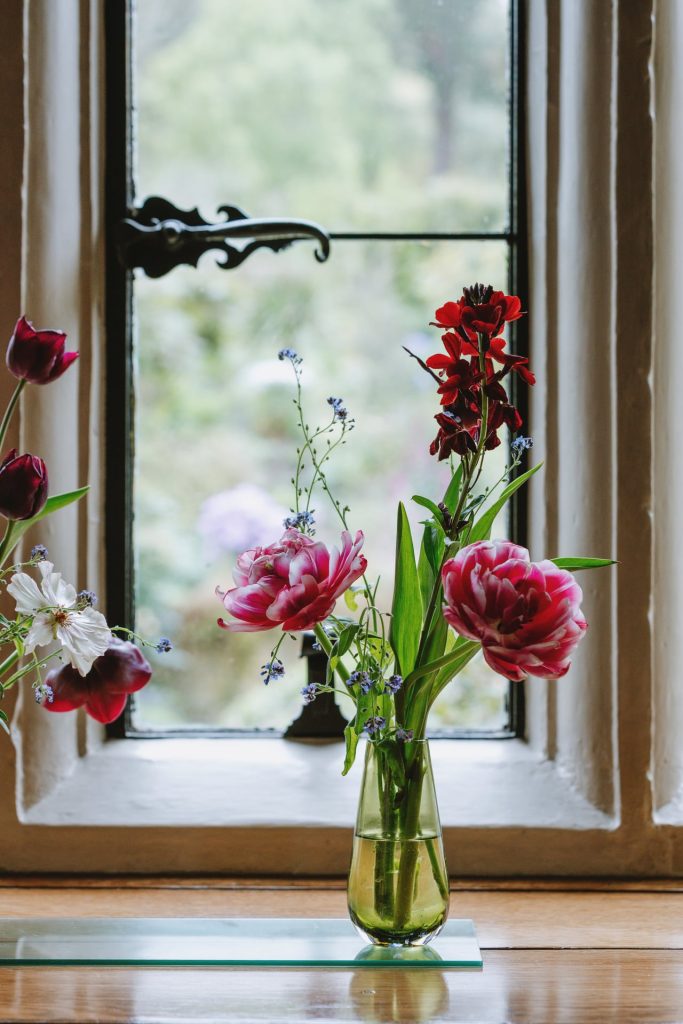 The cutting garden is another essential part of life at Gravetye. Throughout the growing season, it overflows with tulips, dahlias, cosmos, sweet peas, and seasonal flowers grown specifically for the house. Every floral arrangement seen throughout the manor is created using flowers gathered from the estate’s own gardens.
Each morning, the in-house floristry team creates fresh arrangements for the bedrooms and public spaces, ensuring every room carries something of the garden inside. From delicate posies on bedside tables to abundant seasonal displays in the lounges and restaurant, the flowers become another way the gardens quietly shape the guest experience.
Nearby, the apple orchard contains more than 50 varieties of apple, including heritage and increasingly rare cultivars carefully preserved on the estate. In autumn, the branches hang heavy with fruit, which is later pressed into juice or transformed into desserts, preserves, and seasonal dishes at the restaurant. The orchard reflects another important part of Robinson’s philosophy: that productive spaces could be just as beautiful and romantic as ornamental ones.
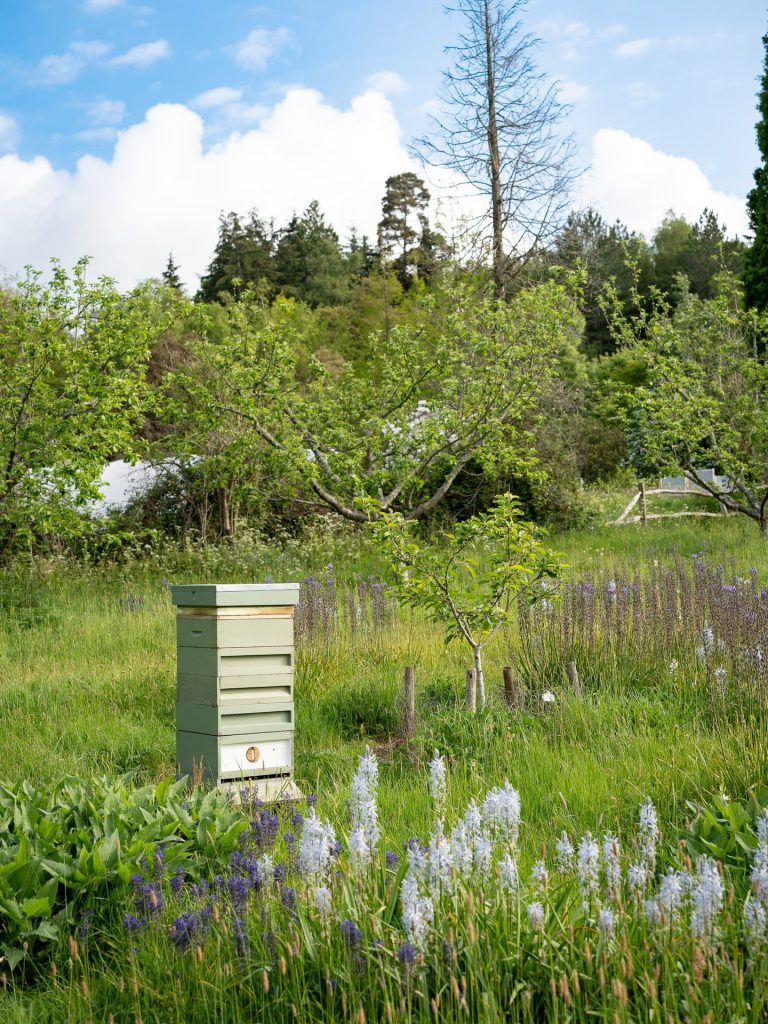
The orchard is also home to Gravetye’s beehives, where bees move between the blossoms, wildflower meadows, and surrounding gardens throughout the seasons. The estate produces its own honey, capturing the changing character of the landscape in each harvest: delicate and floral in spring, richer and deeper later in the summer. It is another small but meaningful expression of the close relationship between the gardens, wildlife, and kitchen.
As the seasons shift into autumn, the gardens become softer and richer. The flower beds become more abundant and overflow with dahlias in all shades. Across the wider estate, the trees blaze with vibrant reds, yellows, and oranges.
Inside the manor, the connection to the gardens continues throughout the interiors. Floral fabrics, botanical motifs, and richly textured wall coverings reflect the colors and romance of the landscape outside, creating a sense that the gardens flow seamlessly into the house itself.
Guests are also invited to experience the gardens more deeply through seasonal garden tours that offer insight into the estate’s history, William Robinson’s enduring influence, and the ongoing work of Tom Coward and his team. Walking through the gardens alongside those who care for them reveals not only their beauty but the extraordinary amount of knowledge, craftsmanship, and quiet dedication behind them.
Bushmans Kloof Wilderness Reserve & Wildlife Retreat, South Africa – Where Wilderness Blooms
 |
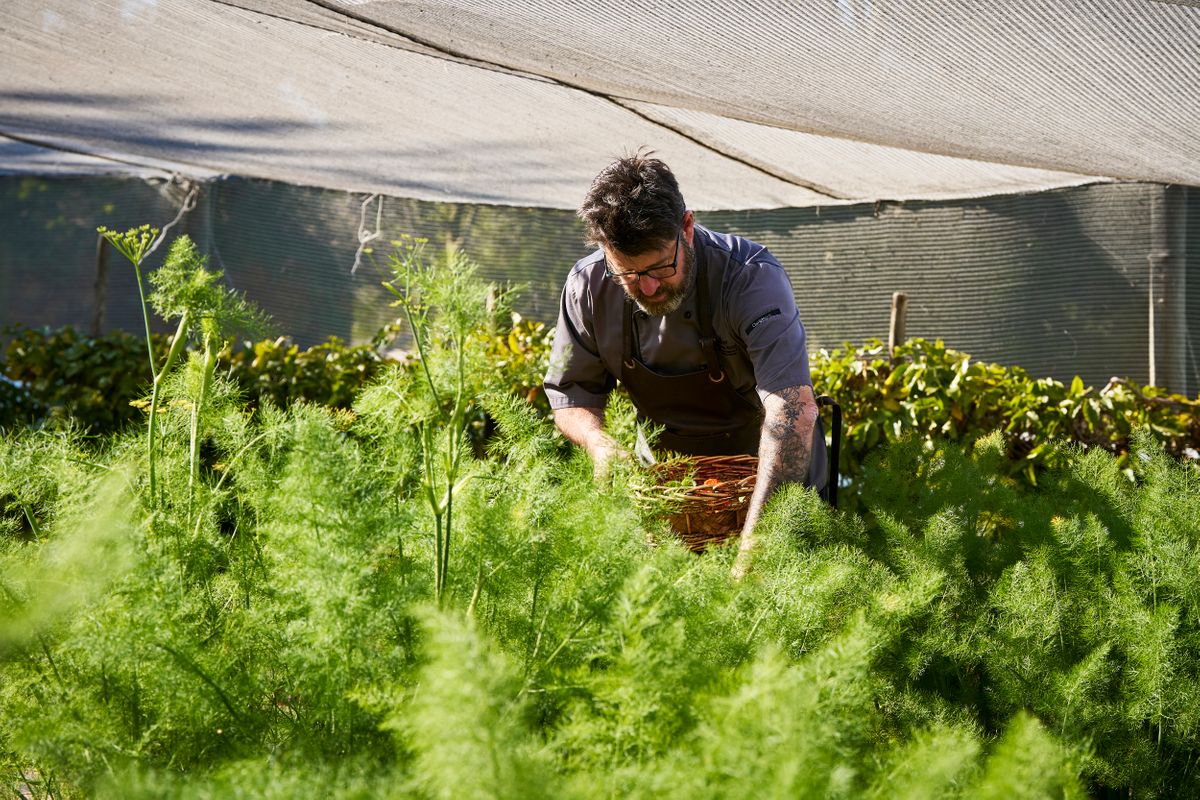 |
| Harvested this afternoon, served tonight. The freshest flavors of the Cederberg, straight from their organic garden to the guests’ plates at Bushmans Kloof. | |
There are places where gardens are carefully arranged, and then there are places where they simply belong. At Bushmans Kloof Wilderness Reserve & Wellness Retreat, the line between cultivated space and wilderness dissolves, creating something far more immersive. Set within a 7,500-hectare private reserve in South Africa’s Cederberg Mountains, Bushmans Kloof is a landscape shaped by time and biodiversity, where the surrounding fynbos vegetation forms part of one of the richest floral kingdoms on earth. Here, horticulture is not ornamental. It is purposeful, seasonal, and deeply connected to how guests experience the property.
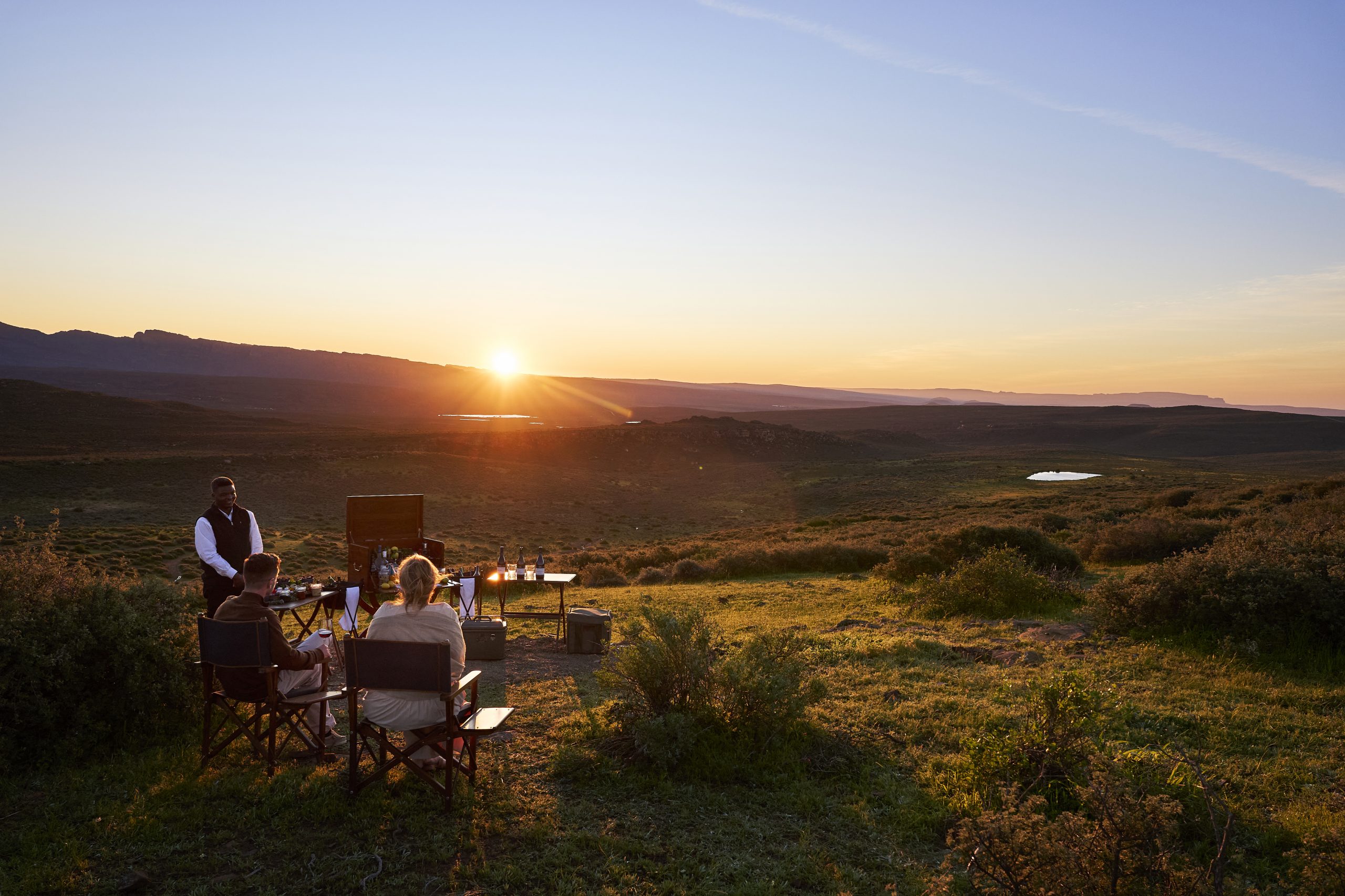 Watching the Cederberg reserve exhale as the light softens, casting long, golden shadows.
This is the natural rhythm of sundowners at Bushmans Kloof.
As the light softens in the early evening, the reserve seems to exhale. The warmth of the day lingers in the leaves, while the mountains begin to cool, casting long, golden shadows across pathways and terraces. At Bushmans Kloof, this moment is part of a natural rhythm that guides the entire property. The gardens, much like the wilderness beyond them, operate as a living clock, shifting with the seasons and subtly shaping everything from mood to menu.
Nowhere is this more evident than during flower season in the Cape, which typically unfolds between September and early November. During these fleeting weeks, the reserve transforms into a vibrant tapestry of wildflowers, with vast stretches of landscape carpeted in color following the winter rains. It is a brief but extraordinary moment when the fynbos reveals its full brilliance and the broader landscape becomes part of the garden itself.
Even outside of peak bloom, the sense of discovery remains. Those who take the time to wander beyond the obvious will find quieter corners — the lodge’s historic Walled Garden, for example — where the pace slows, and the experience becomes more personal.
 The working heart of hospitality: Executive Head Chef Oliver Coetzee guides the menus
daily, ensuring every dish is composed with fresh, organic herbs and vegetables
harvested straight from the kitchen garden.
A Garden Led by the Kitchen
At Bushmans Kloof, the story of the garden is not driven by a single gardener, but by a collective effort across the team, guided by a shared commitment to sustainability and seasonality. At the heart of this sits Executive Head Chef, Oliver Coetzee, whose approach to food places the garden firmly at the center of the guest experience.
Here, the kitchen garden is a working, evolving space that directly influences what appears on the plate each day.
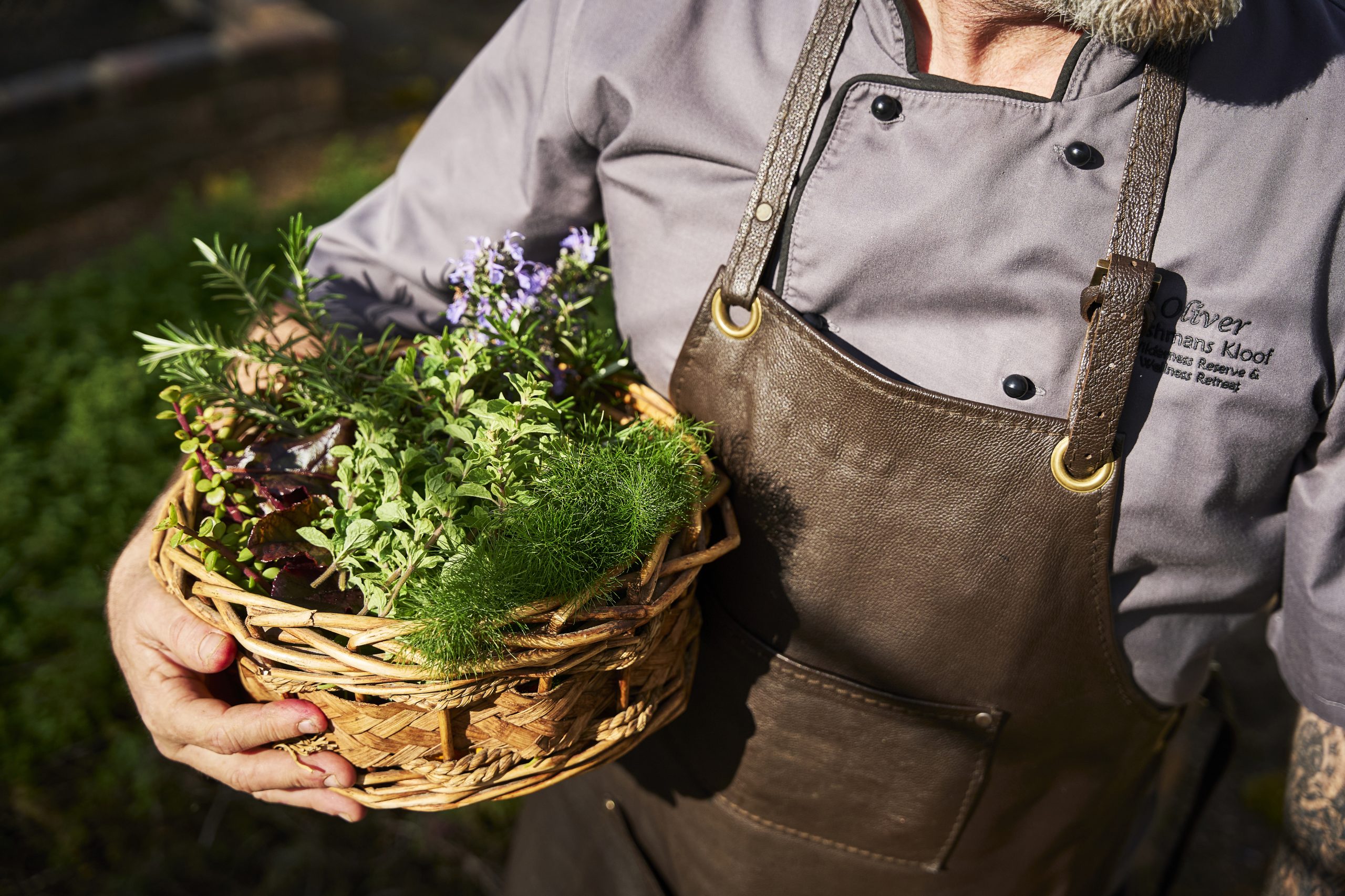 The fragrant heart of the estate’s cuisine: A daily harvest from the organic garden ensures every dish
at Bushmans Kloof is composed with the freshest, most authentic flavors of the Cederberg.
Fresh herbs and vegetables are harvested daily from the organic garden, shaping menus in real time and reflecting the natural rhythms of the reserve. This connection is not just about freshness, but about provenance — understanding exactly where ingredients come from, and allowing the landscape to guide the cuisine.
There is also a strong sustainability ethos underpinning the process. All crops are grown organically, with careful attention paid to what thrives naturally in this environment. Surplus produce is not wasted, but instead shared locally, ensuring the garden’s benefits extend beyond the boundaries of the reserve itself.
The result is a guest experience that feels instinctively connected to place. A herb picked that morning appears, just hours later, as part of a carefully composed dish. Indigenous ingredients find their way into menus that celebrate the region, including a dedicated Fynbos menu that captures the essence of the Cape through locally foraged and grown flavors. It is a subtle but powerful form of hospitality. The garden actively supports the experience.
Even the smallest details reinforce this connection. Guests encounter rooibos-inspired touches throughout their stay, grounding luxury in something distinctly local and deeply rooted in the land.
The Plants that Define the Place
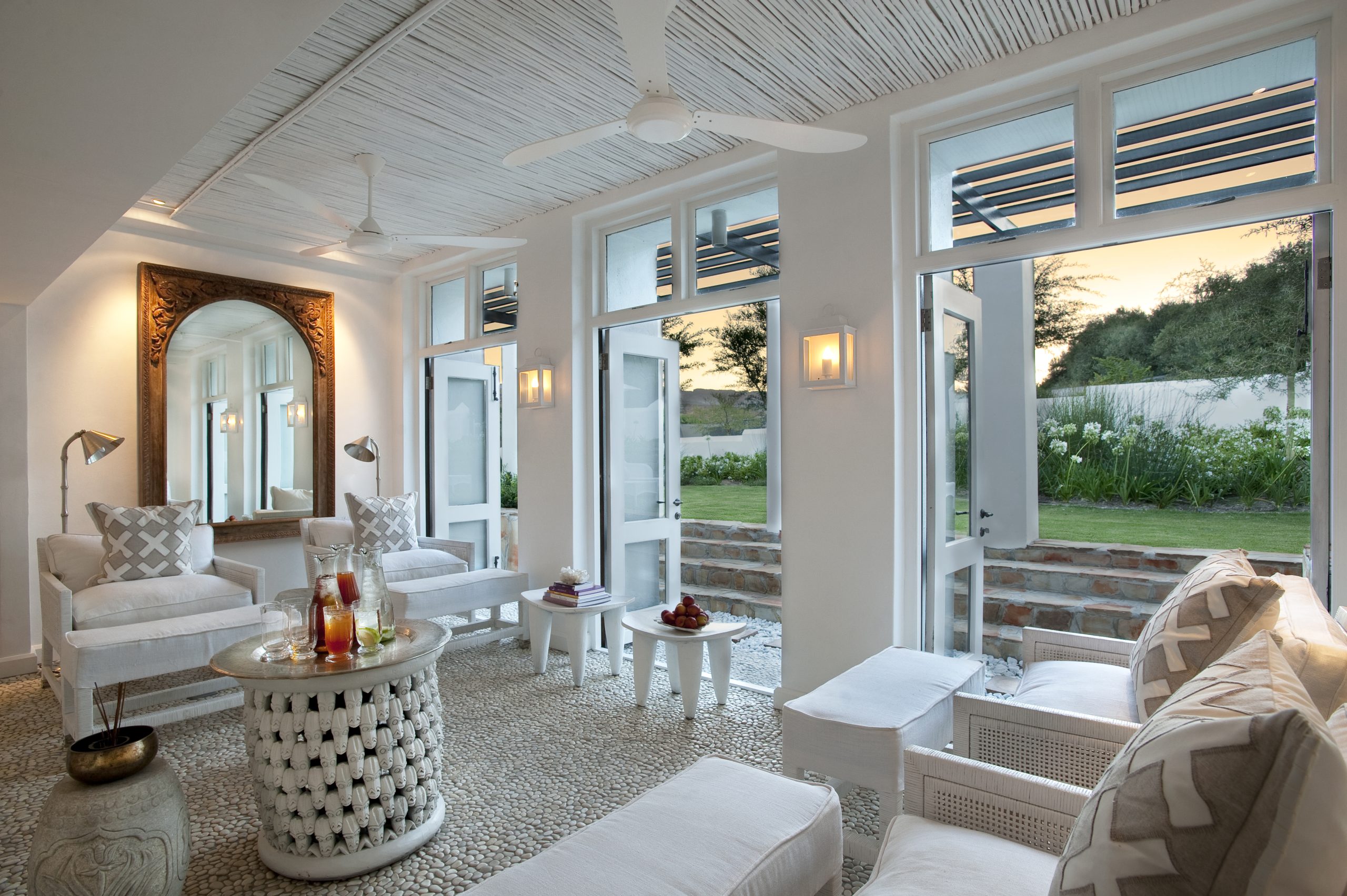 The Bushmans Kloof Spa offers quiet restoration, with subtle, local touches like refreshing
iced rooibos tea grounding the wellness journey.
If there is a single botanical thread that runs through Bushmans Kloof, it is fynbos. This remarkable plant kingdom, found almost exclusively in the Western Cape, is one of the most biodiverse on Earth, with thousands of species adapted to thrive in this unique environment. Among them, rooibos stands out as a defining element of the region, grown only in the Cederberg and closely tied to its cultural and natural identity. Nowadays, enjoying Rooibos as a tea is perhaps its most recognized form — a delicious, healthy, and caffeine-free drink that is packed with antioxidants. It has a unique, sweet, and slightly nutty taste, which has a soothing effect on the digestive and central nervous systems. Jugs of iced rooibos tea can be found throughout the reserve, from the Homestead Lodge to the spa lobby, and it is best enjoyed poolside on a warm Cape day.
Throughout the reserve, fynbos reveals itself in layers, from delicate flowering herbs to hardy shrubs shaped by wind, drought, and time. But it is during spring, when wildflowers bloom in abundance, that the scale of this biodiversity becomes truly visible.
The gardens at Bushmans Kloof are part of a much larger vision — one that balances luxury with conservation and recognizes that the two are inherently linked.
Since its transformation into a wilderness retreat, the focus has been on restoring and preserving a landscape of extraordinary ecological value, ensuring that the natural environment continues to thrive for generations to come.
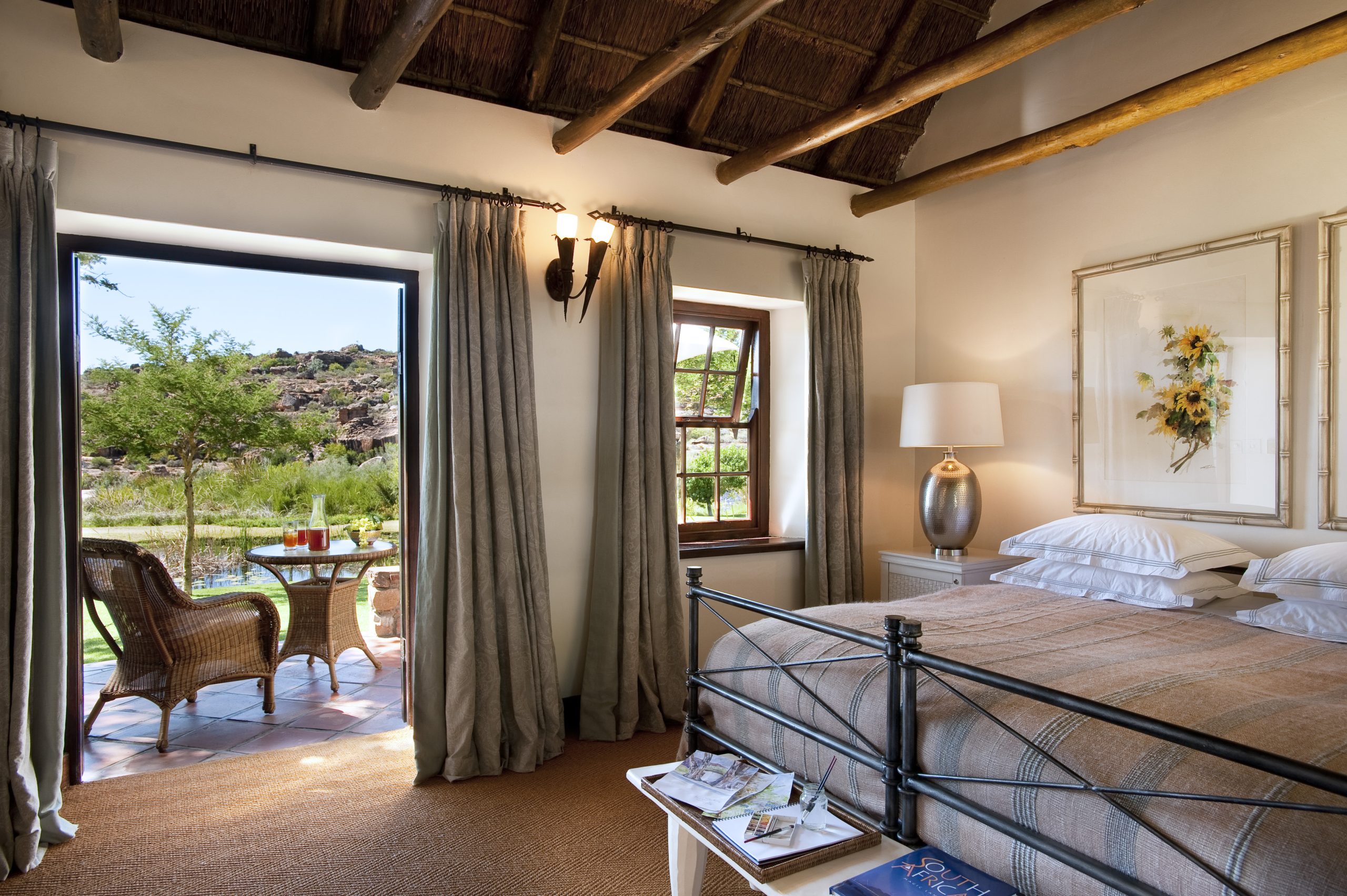 Wake up to the sight and scent of the fynbos. Every detail of the interior is designed for tranquility,
with the boundless nature of Bushmans Kloof waiting just outside the door.
This philosophy extends into every aspect of the guest experience, from the food on the table to the way the land itself is cared for.
Meadowood Napa Valley, California – A Private Retreat Shaped by Nature
 An aerial view of the 250-acre private retreat: Meadowood is gracefully tucked into the
forested hillsides, showing a powerful blend of mindful stewardship
and luxurious hospitality in the heart of Napa Valley.
Even in the inspiring landscape of Northern California wine country — with its rolling mountains, bountiful farms, and sweeping vineyards — Meadowood Napa Valley stands out for its natural heritage and appeal. Graced by an arcadian setting, tucked peacefully among 250 acres of private forested hillsides, the St. Helena resort invites guests to immerse themselves in an estate of ecological interest.
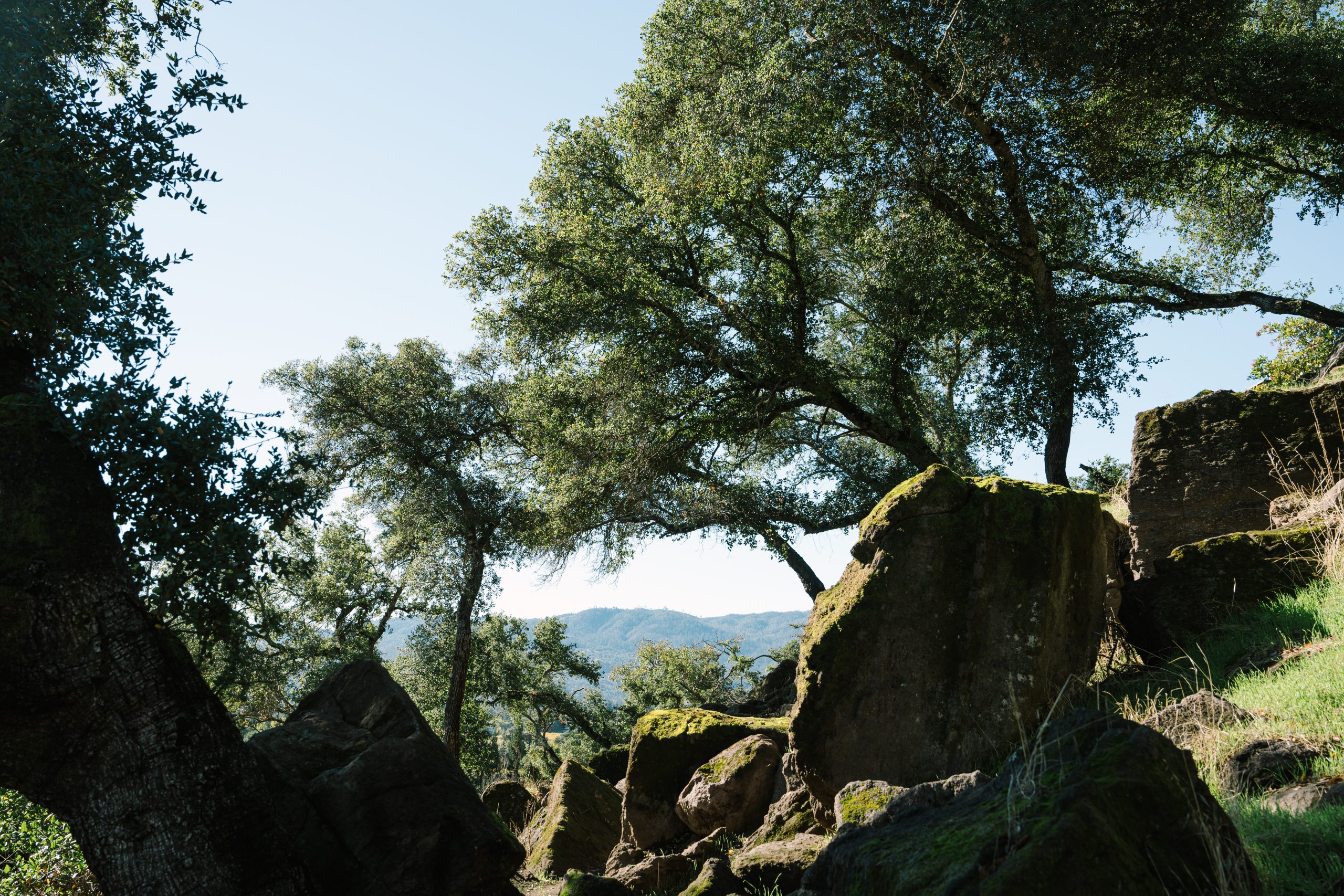 The reward of the climb: expansive, stunning valley views over the 250-acre estate. Hike
Meadowood’s private trails to explore the forested hillsides and connect directly
with Napa Valley’s restorative, native landscape.
Situated at the base of the Vaca Mountains as they gently descend to the Napa Valley floor and Napa River corridor, the property encompasses an extraordinary transition of ecosystems within a relatively small area. This progression from forested mountainside to valley oak woodland to riparian zone supports remarkable biodiversity. Meadowood’s location provides a unique habitat for a wide variety of wildlife; it has documented more than 100 bird species in a single year.
A mindful steward of the land, Meadowood has long committed itself to the estate’s native flora and fauna. Guests may take note of the native pollinator gardens in the vicinity of the Meadowood Labyrinth, seamlessly integrated along the three-mile-long hiking trails that encircle the property’s perimeter. Additional pollinator gardens at opposite ends of the estate help create vibrant habitat corridors throughout the property, with a focus on supporting pollinator species, including the endangered monarch butterfly.
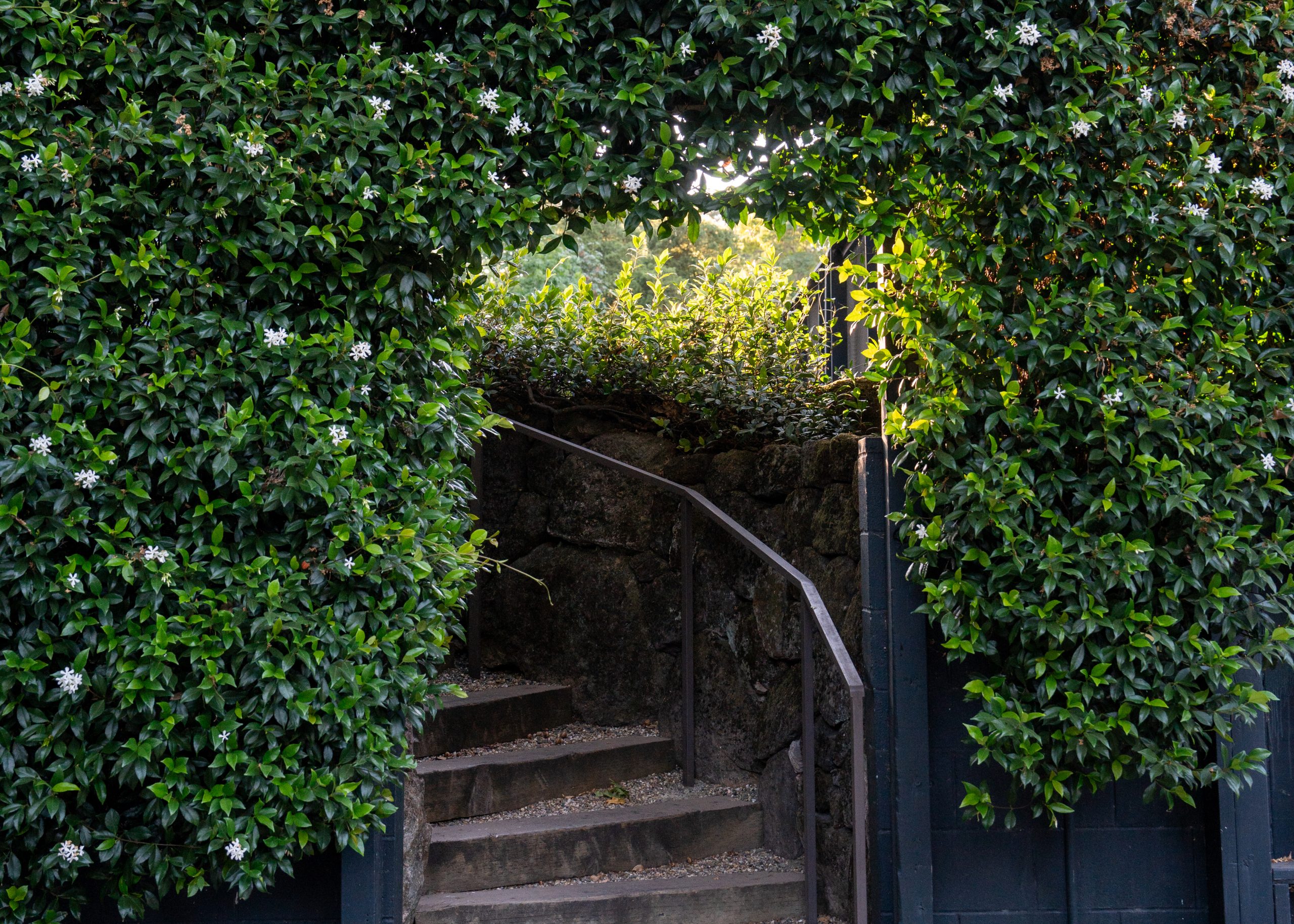 The fragrant spiral staircase: A curated moment where the rich, sweet scent of jasmine meets
Napa Valley luxury, guiding guests into the peaceful sanctuary of Meadowood.
The estate’s woodlands are maintained with a guiding evolution toward native, drought-tolerant, and ecologically resilient species. More than 3,000 coast redwoods have been planted to gradually transition portions of the forest canopy to a native redwood ecosystem. Along the warmer western-facing slopes of the estate, Meadowood has planted coast live oak trees. Over 1,000 native shrubs representing more than 10 California species have been introduced to strengthen the understory and support wildlife habitat throughout the forest ecosystem. Walking the estate’s forest trails allows guests to experience the quiet beauty, biodiversity, and restorative nature of Napa Valley’s native landscape.
Spring in the Meadowood Valley
 Where color meets quiet luxury: The Brunfelsia Pauciflora in bloom, reflecting the thoughtful
integration of vibrant plant life into the serene sanctuary of Meadowood Napa Valley.
Spring is an especially beautiful season at Meadowood. Flowering dogwoods greet guests as they arrive on property, while native manzanitas, azaleas, and camellias provide layers of seasonal color throughout the landscape. The maroon blossoms of the black oak emerge delicately before transitioning into their summer canopy of green. Native salvias, ceanothus, buckwheat, and wildflowers attract bees, butterflies, and hummingbirds across the estate, creating a landscape that changes subtly from week to week with the rhythms of Napa Valley.
Guests experience the landscape not simply as a cultivated garden, but as a living ecosystem — one alive with birdsong, pollinators, native blooms, and the changing light of the valley throughout the seasons.
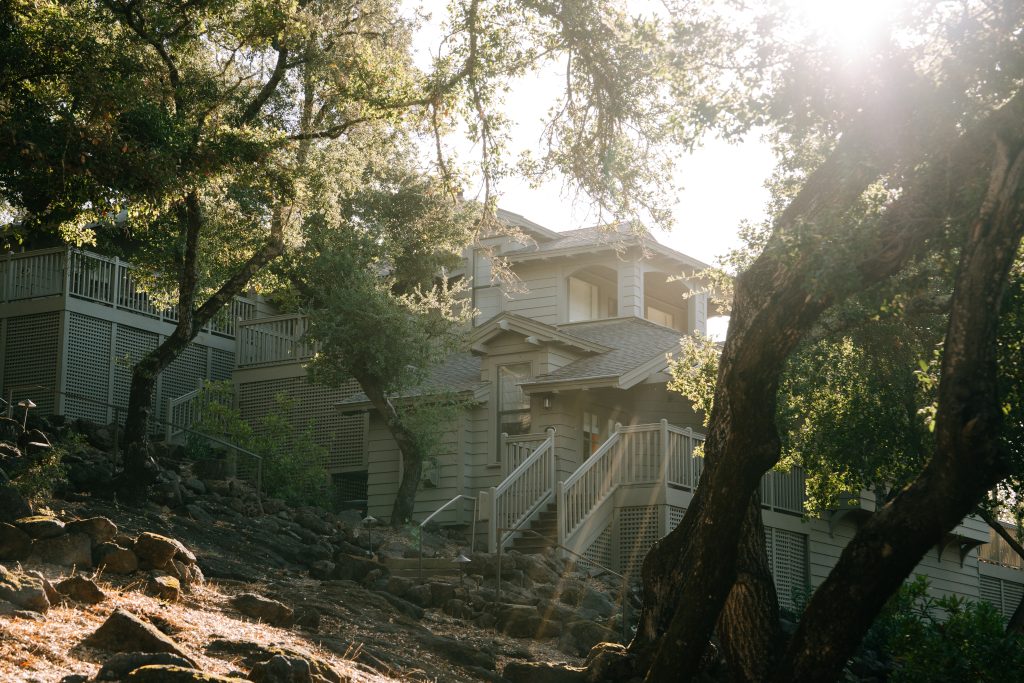 The ultimate Napa Valley immersion – from the Treeline Suite, the view extends over the native
landscape, reinforcing Meadowood’s commitment to natural heritage and a serene guest experience.
Natural Grazing
California’s Mediterranean ecosystem has historically evolved alongside natural cycles of grazing and renewal. Meadowood’s seasonal grazing program is designed to naturally manage grasses and understory vegetation while supporting the long-term health of the landscape.
Each year, approximately 1,000 goats and sheep are brought to Meadowood and neighboring properties to graze more than 300 acres across the surrounding hillsides. Beyond their ecological benefits, the playful goats have also become a guest favorite.
Native Wonder: The Coast Redwood (Sequoia sempervirens)
The coast redwood is one of the most impressive trees in the world and has become an abiding part of Meadowood’s landscape. Native to Northern California, coast redwoods are the tallest trees on Earth, reaching nearly 400 feet, with some estimated to be more than 2,000 years old. As they age, their foliage and trunk cavities provide a nesting habitat and sanctuary for native birds.

Designed for stillness: The welcoming exterior of the Meadowood Spa, a seamless extension of the
forested hillsides, invites guests to shed the outside world and embrace natural rejuvenation.
The trees are recognized for their ecological adaptability, with thick bark that provides natural resilience and foliage that can absorb moisture directly from coastal fog and atmospheric humidity, which helps sustain them through dry summers. Redwoods are also among the world’s most effective trees at capturing and storing atmospheric carbon.
Walking among redwoods is known to conjure an experience that feels both grounding and deeply connected to the natural history of Northern California — a feeling that resonates strongly with guests from around the world.
Ashford Castle, County Mayo, Ireland – Behind the Garden Gate
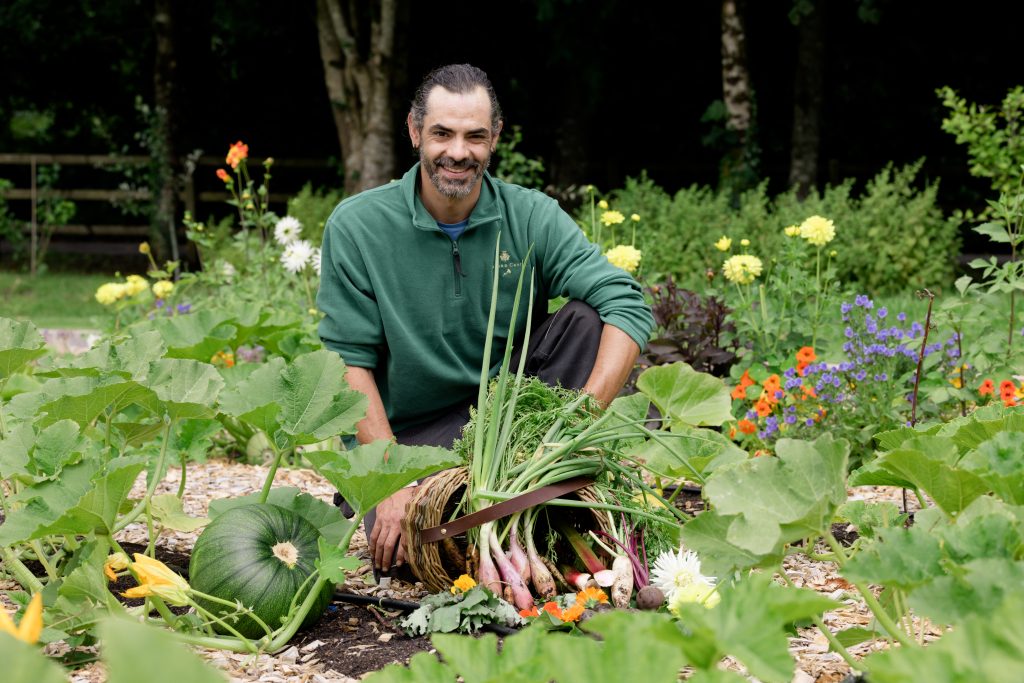 A peek inside the productive kitchen gardens at Ashford Castle, where sustainability is woven
into the daily routine. This rich morning harvest of crisp spring onions, root
vegetables, and edible blooms is destined for the castle’s dining tables just
hours after being pulled from the fertile Irish soil.
At Ashford Castle on Ireland’s wild western edge, horticulture and hospitality share the same table. In the Kitchen Garden, vegetables, herbs, edible flowers, and fruit thrive in a no-dig system first built in early 2022, now spanning nearly two acres with plans for around 90 beds and an expanded walled garden.
In peak season, guests can see heirloom tomatoes, mixed baby vegetables, violet kale, and golden calendula, grown for the kitchen and to attract beneficial insects, alongside an estate beekeeping program increasing to 16 hives. A future orchard of 300 apple trees will add even more flavor to the estate.
Leading it all is Alex Lavarde, Head Gardener, with the talented Niamh Flannelly and Phillip Higgins. Guests can meet one of the team members on the summer Kitchen Garden Tour, walking the gardens and hearing how they shape the menus.
The garden also touches the guest experience through the Cré experience at Squire Danagher’s, where foraged baskets become part of an immersive, hands-on culinary moment. For guests, it is a rare chance to step behind the scenes and taste the estate, soil to plate.
Look out for Ashford Castle’s hero produce, the Guinness apple tree, which dates back to the Guinness period, and which, hopefully, will welcome the first estate truffles next October for guests to enjoy!